
Color Chart Diamond
Diamond colour is graded on a scale from D (colourless) to Z (light yellow or brown). Use the interactive chart to see what each grade means, how noticeable the colour is likely to be face-up, and which setting metals flatter each range — then use the comparison worksheet to weigh colour against cut, clarity and carat.
- Free to use
- No sign-up
- Runs in your browser
Diamond colour chart
Screens cannot show real diamond colour accurately; the swatches only illustrate the direction of change.
Diamond 4Cs Buying Kit
Printable D–Z colour and clarity reference charts, a diamond comparison worksheet (Excel), a jeweller visit checklist and a ring size and setting notes sheet.
- Colour chart (PDF)
- Clarity chart (PDF)
- Comparison worksheet (XLSX)
- Jeweller visit checklist (PDF, DOCX)
Formats: PDF, XLSX, DOCX. Instant download after payment (link valid 72 hours, up to 5 downloads). AI-assisted: the templates were drafted with AI help and reviewed and laid out before publishing.
$4.00 USD, one-time 4 files · about $1.00 each
- Instant download
- 7-day refund
- Secure checkout by Stripe
7-day money-back guarantee. Full refund within 7 days of purchase, even after you download.
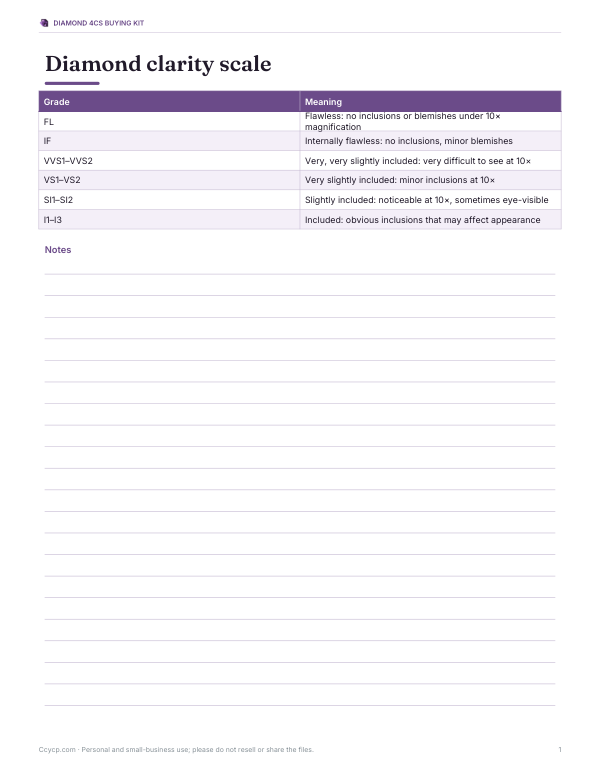
Free sample: Diamond Clarity Chart (PDF, 70 KB)
Full refund within 7 days — see the refund policy and license.
Free printables
Single sheets you can print right now, no sign-up. The full pack adds every sheet in one download plus the editable files.
 Printable Jeweller Visit Checklist
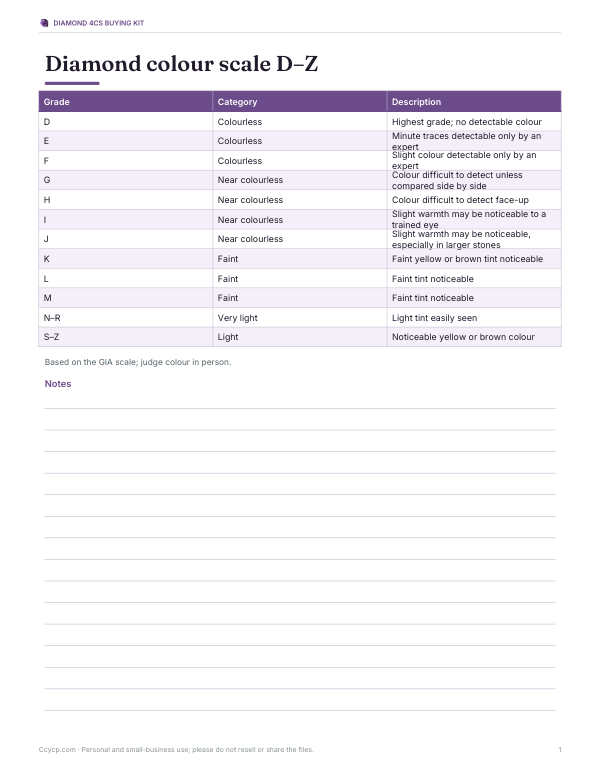
The D–Z diamond colour scale
| Grade | Category | Description |
|---|---|---|
| D | Colourless | Highest grade; no detectable colour |
| E | Colourless | Minute traces detectable only by an expert |
| F | Colourless | Slight colour detectable only by an expert |
| G | Near colourless | Colour difficult to detect unless compared side by side |
| H | Near colourless | Colour difficult to detect face-up |
| I | Near colourless | Slight warmth may be noticeable to a trained eye |
| J | Near colourless | Slight warmth may be noticeable, especially in larger stones |
| K | Faint | Faint yellow or brown tint noticeable |
| L | Faint | Faint tint noticeable |
| M | Faint | Faint tint noticeable |
| N–R | Very light | Light tint easily seen |
| S–Z | Light | Noticeable yellow or brown colour |
The scale, developed by the Gemological Institute of America (GIA) and now used worldwide, starts at D rather than A to avoid confusion with older, inconsistent systems. It grades the absence of colour in white diamonds — the less colour, the higher the grade. Diamonds are graded face-down against master stones under controlled lighting, because colour is easiest to judge from the side.
What the categories mean in practice
- D–F (colourless) — the rarest grades; differences between them are nearly impossible to see without master stones.
- G–H (near colourless) — very popular because colour is hard to detect face-up, especially in well-cut round diamonds.
- I–J (near colourless) — a slight warmth may be visible to an experienced eye, particularly in larger stones or fancy shapes.
- K–M (faint) — a noticeable warm tint; some buyers like the vintage look, especially in yellow or rose gold.
- N–Z (very light and light) — clearly tinted stones; beyond Z, strongly coloured diamonds are graded as “fancy colour” on a different scale.
Factors that change how colour looks
| Factor | Effect |
|---|---|
| Size | Larger diamonds show more body colour |
| Cut quality | Well-cut round brilliants reflect light that masks colour; poor cuts can look more tinted |
| Shape | Step cuts (emerald, Asscher) and elongated shapes can show colour more, especially at the ends |
| Setting metal | Yellow and rose gold make warm tones look natural; white metals emphasise colourless stones |
| Fluorescence | Blue fluorescence can make I–M stones appear whiter in daylight; strong fluorescence occasionally makes a stone look hazy |
| Lighting | Warm indoor light hides tint; daylight reveals more |
Colour vs the other Cs
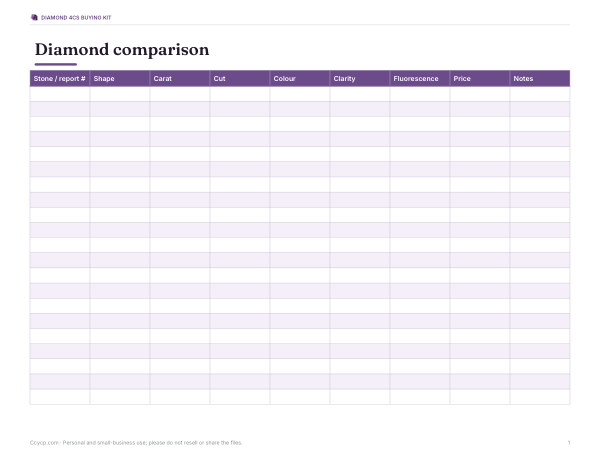
Colour is one of the “4Cs” with cut, clarity and carat weight. Most gemologists advise prioritising cut, because it controls brilliance and can mask a little colour and clarity. Many buyers choose G–H colour as a balance between appearance and budget for white metal settings, and I–J for yellow or rose gold. The comparison worksheet in the pack lets you list candidate stones side by side so the trade-offs are clear.
How to check colour when buying
- Ask for the grading report and confirm the report number is laser-inscribed on the girdle where possible.
- View the diamond face-up and from the side on a white card in daylight.
- Compare it with a stone one or two grades higher and lower if the seller can show them.
- Look at the diamond in its intended setting metal.
- Consider fluorescence in the report and view the stone under daylight or a UV source.
Grading reports from different laboratories are not always equivalent; many buyers prefer reports from long-established independent laboratories. Check the report on the laboratory’s own website.
Worked example
A buyer choosing a 1-carat round brilliant for a yellow gold engagement ring compares a G and an I colour diamond with the same cut and clarity. Face-up in the yellow gold setting, both look white to them; side by side on a white card, the I shows a hint of warmth. Following the chart’s guidance that I–J suits yellow gold, they choose the I and put the difference in budget towards a better cut grade.
Lab-grown diamonds
Laboratory-grown diamonds are graded on the same D–Z scale and many are sold in the colourless and near-colourless ranges. Grading reports should state that the diamond is laboratory-grown. The appearance guidance on this page applies equally to natural and lab-grown stones.
What this chart is not
This page explains the grading system; it is not a grading service or a valuation. Real colour can only be judged in person or by a gemological laboratory with master stones. Prices vary widely by market, shape, size and the other Cs, and we do not quote them.
Privacy
The chart runs in your browser and stores nothing.
Frequently asked questions
What is the best colour grade for a diamond?
D is the highest; many buyers find G–H looks colourless face-up in white metal, and I–J suits yellow gold.
Why does the scale start at D?
To avoid confusion with older grading systems that used A, B and C inconsistently.
Can you see the difference between D and G?
Rarely face-up; usually only side by side or against master stones.
Does setting metal affect colour?
Yes. Yellow and rose gold make warmer grades look natural; white metals emphasise colourless stones.
Are lab-grown diamonds graded the same way?
Yes, on the same D–Z scale.
Can this page grade my diamond?
No. Colour must be graded in person by a gemologist or laboratory.
Is a colourless diamond always better?
Not for everyone. Many people prefer near-colourless grades for value, and warmer grades can look beautiful in yellow or rose gold.
What colour grade do most engagement rings use?
Many fall in the G–J range, balancing appearance and budget.